
My friend got the apartment she was obsessed with for six years. She got her hands on the floor plan and endlessly fantasized about the large windows, the galley kitchen, a particular morning light entering the master bedroom she had described to me so often I could draw it myself. She got the keys on a Tuesday and by Saturday she was sending me pictures of the next place, the bigger one she’d move into after the next promotion.
I’ve been mulling that over. This inescapable ‘want’ most of us have. We see a door and we hope to get in. We get in, we get the thing, we savour it a little, and in roughly the time it takes a kettle to come to a boil, we have already started looking for the next thing, the better thing, the one that will finally do what we believed this one would do and, for some reason, didn’t.
It has even become more common, I think, to catch people in the act of getting exactly what they asked for and looking disappointed or cheated by it. I see it in myself too, if I’m honest. Seconds after good news lands, some part of my mind has already handed me a brand-new, almost impossible thing to go and get.
I don’t think this is a flaw, though, so I’ll save us some trouble and ask the question I’m actually interested in, which is not how to stop, because if I’m being fair, that seems impossible. When do we put down the life we’re planning long enough to live the one already in our hands?
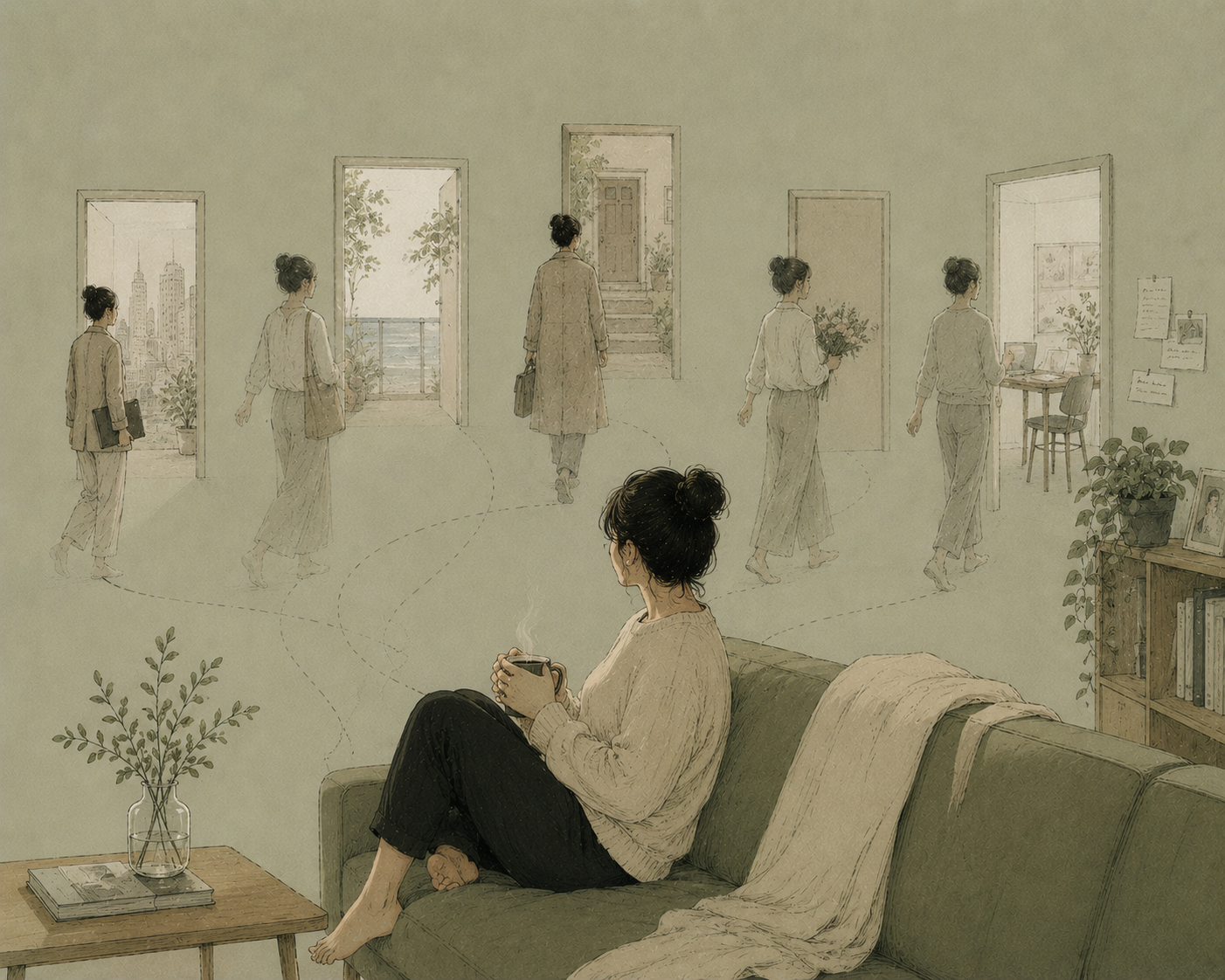
This is what I noticed. The best night of a holiday is often the one before it. Your bag is packed, your flights are confirmed, your dress is laid out, and the whole trip exists in its perfect imagined form. No one is tired, no restaurants are closed, no food poisoning, no catcalling. The Sunday you plan the week ahead is the same and so is the hour before the party.
And so, some of the most exquisite pleasure available to a human being is the pleasure of expecting something. And it’s a pleasure with its flaw built into its design, which is that it depends entirely on the thing not yet being here. The moment it shows up, it stops being the future and becomes the present, which is to say it joins the long list of ordinary things you already have, and the mind goes looking out the window again. We are creatures who can taste a thing before it exists, which is magical, even if it is also the reason we are never quite full.
Adulthood, when it finally turns up, presents itself as a series of doors, and someone has told you, or you absorbed it without meaning to, that behind one of them is the room where you get to stop. You pass the exams, get the degree, then the job, then the better job, then the flat, then the person, then the bigger house, then the child. Every milestone sold as a destination turns out to be a corridor with another horizon waiting at the end of it. You reach the end and discover that all you can see is more horizon. The horizon, particularly cruel because it moves at precisely your walking speed.
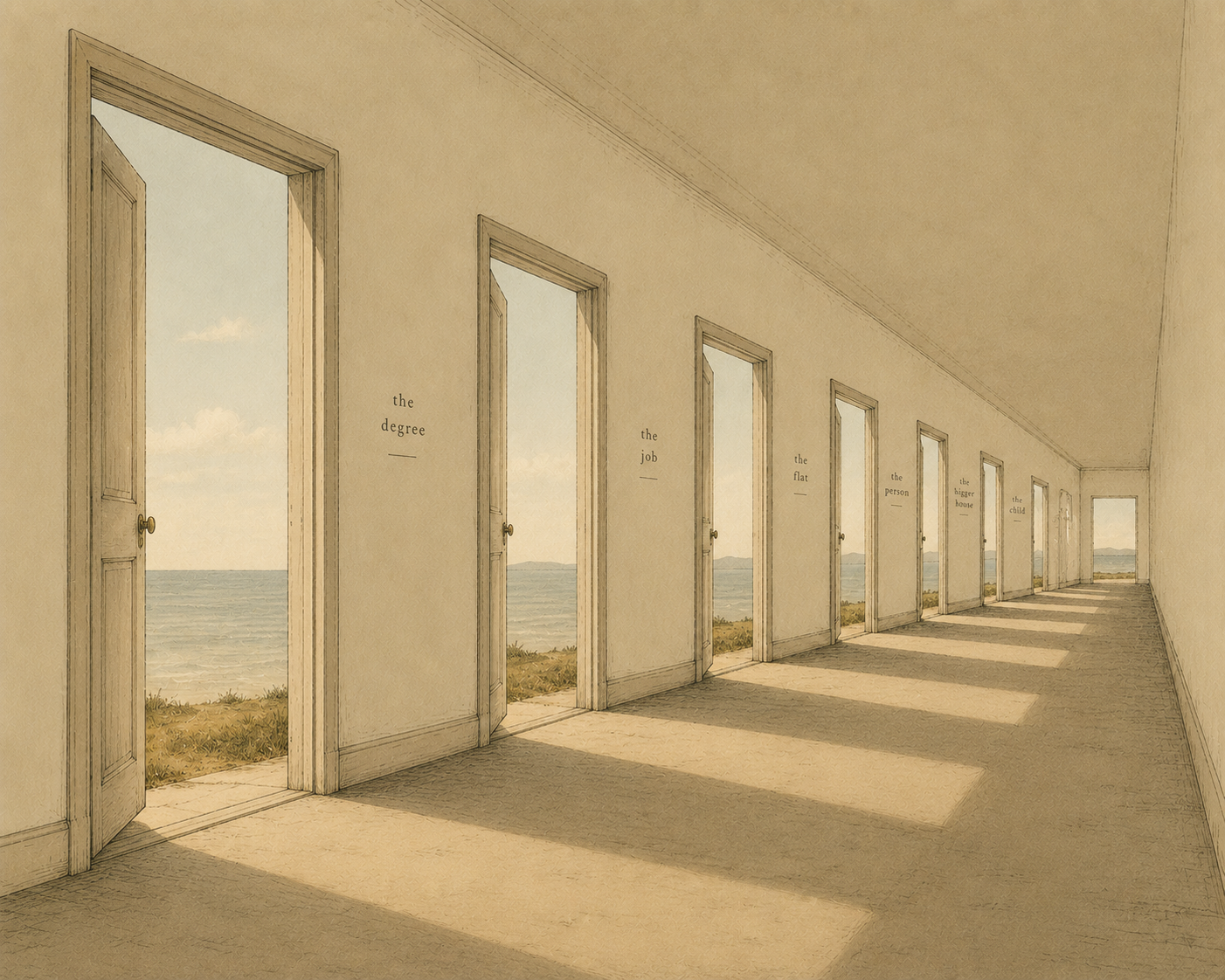
The adulthood brochure never warns you that you can reach every milestone you set and still have the same hunger intact, and then some. The extra appetite you picked up on your way, a proof of your success.
Modern life understands this very well. The whole machinery of it runs on the small renewable engine of your dissatisfaction. Not despair. Your dissatisfaction. A constant drum of almost. They are not selling you the serum, they’re selling the woman you’ll be once the serum works, and that woman is constantly out of reach.
I say this, obviously, not to scold the impulse, but to confess to it. I am not above it. I am writing this on a laptop I was sold as a better version of one I already had. I only write about this because I am sometimes exhausted by all the things that I want.
It isn’t all bad though. Wanting built the world we live in. Every bridge was somebody refusing to accept the river. Every book that undid you in your teenage years and then your twenties existed because someone wanted badly enough and spent years making a universe that didn’t exist. Contentment, for all of its loveliness, has never really finished anything. I think it was people who could not leave well enough alone who gave us nearly everything we love. So wanting itself was never the problem. I guess it is simply the appetite of a living thing.
We want because we are alive. There’s no ending where I cure it, because I do it too.
Elsewhere in this issue
→ Five Ways to Spend Five Minutes
A gentle reminder that small pockets of time can hold more meaning than we think.
On travel, wanting and the temporary feeling of belonging somewhere new.
A curious look at loneliness, human connection and the lengths we sometimes go to create it.