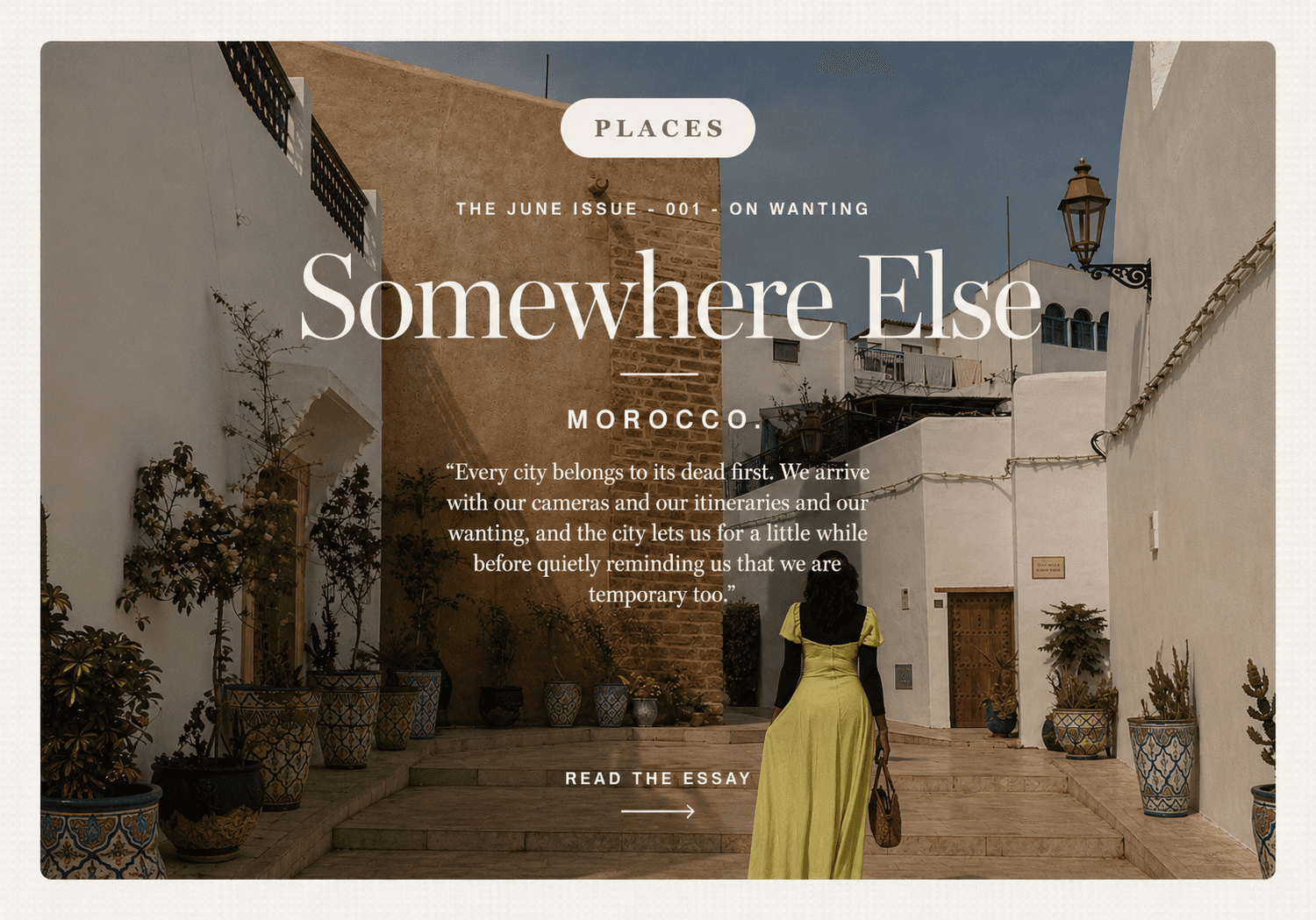
Marrakech • Casablanca • Rabat
The first night in Marrakech I was not dressed for it. It was late in February and I had packed for an idea of the place rather than the place itself. The afternoons were mild and then the sun went down and the cold came up out of the ground, and by evening, in the square, I could watch my own breath leave me.
Osama noticed before I admitted it. He had been my guide all that first day, and when he saw me folding my arms over and over he took off his jacket and handed it to me without making a thing of it. I wore that jacket for most of the rest of my time in Marrakech. I kept meaning to feel awkward about it and never found the time. He walked me into the square after dark and stood back, and even before we got there I could hear it.
Jamaa El-Fnaa, the famous night market. You step into it and the square swallows you, and you are just a body among bodies, moving the way water moves, which is to say, not entirely by choice. Lanterns strung up like low orange stars. Smoke rising off the grills in fat ropes, and underneath it cumin and burnt fat and something sweet I never identified. A man turning skewers. Another shouting a figure at me, come, come, sister, best food, as if I had already agreed. Orange juice carts with their pyramids of fruit stacked so high it seemed rude to gravity. A henna artist grabbed my wrist and I pulled back, laughing, and she laughed too, already reaching for the next wrist.
Somewhere a drum, then a flute, that thin snake-charmer sound that goes straight into your teeth. Children weaving through legs. A man trying to balance on a stack made up of different objects. Two old men arguing with great seriousness over what looked like nothing. The Koutoubia minaret floodlit in the distance, calm above all of it, like an adult keeping a watchful eye over a party.
I stood in the middle and felt the thing I always feel. The feeling where you are standing in a city that is not yours and some part of you starts fantasising about the life you could live there. The flat you would rent, the hidden corners of a market you would learn. The funnier, lighter version of you. The version you've always wanted to become. I want to live here. It was true, even if it was a real feeling attached to nothing.
What is that, though. Honestly. Curiosity? Escapism? Restlessness? I genuinely do not know.
What I do know is that I need more room. I have a full life and I want a fuller one. A good way of describing it would be that I have rooms in me the life I built does not use, sitting there with the lights off. And travelling switches a few of them on.
It was cold in Marrakech, properly cold, which I kept being surprised by, as if the weather app had personally lied to me. Abuja does not do this. Abuja had ‘wet heat’ that follows you indoors and settles on your chest. Here the cold had an edge that dried your lips and made the mint tea feel like the whole point of the evening. And that is exactly the kind of thing I notice and build an entire imaginary life on.
I could be a different woman in a cold like this.
I am telling this out of order. Marrakech came at the end, and I will get back to it. But I arrived through Casablanca, and Casablanca is where I met Nouna.
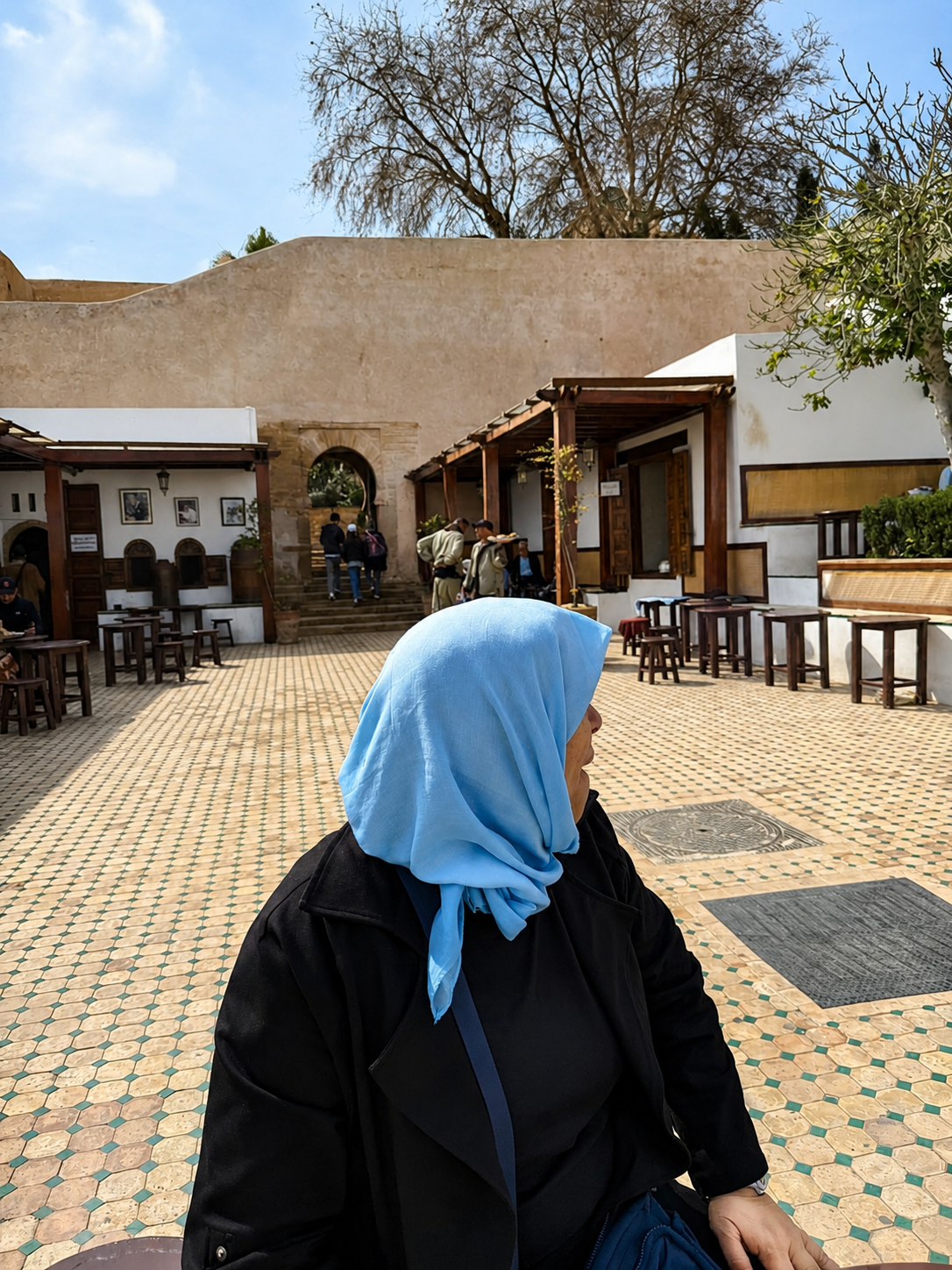
She was meant to be a guide but turned out to be closer to somebody's mother. The kind who decides within an hour that you are not eating enough and makes it her problem. She drove me up to Rabat one morning and talked the whole way, history and gossip folded into one. This sultan, that betrayal, the price of fish now compared to before. She told me about her two daughters. One was all dresses and mirrors, hours in the bathroom, a romantic. The other couldn't be paid to brush her hair. She said it the way mothers everywhere do, half complaining and entirely in love. I have an aunt who describes her own two girls in a similar way, in Hausa, in a kitchen in Kaduna.
Casablanca had been described to me as the working city with no charm. I disagree. Parts of it are loud and grey, while other parts have beautiful, endless white buildings with the cleanest air you could imagine. There is a quarter called Le Petit Paris, or Little Paris, with old French streets, white buildings with curved balconies and iron railings gone soft with rust, and cafés whose chairs are all turned to face the street. Nouna walked me through it without ceremony, pointing out a balcony where some actress used to live, unimpressed in the way only a local can be.
And then the old thought arrived on cue. I should go to Paris. Not because this street was particularly magical but because it reminded me there was a Paris, and I had not seen it, and the wanting simply started up again on its own.
I started to wonder about how wanting multiplies. Its stomach, a bottomless pit, never getting full. You give it a beautiful thing and it does not say thank you and rest. Instead it says, and now that one, and that one. I was standing in one country, looking at a neighbourhood built to imitate a second, already wanting the third, and I knew the real Paris would only make me want somewhere else, on and on, a corridor of doors with no last door.
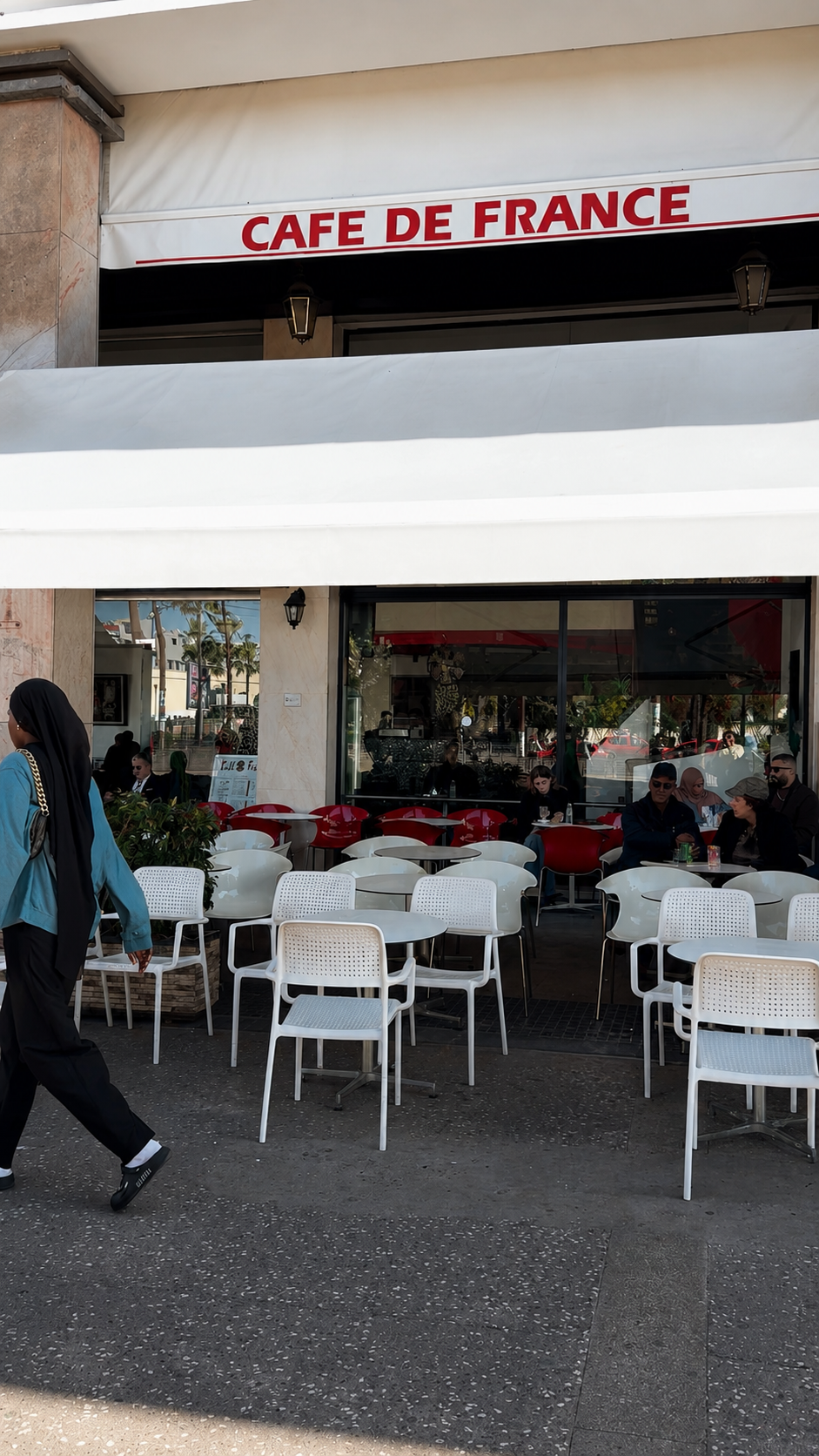
"Khadijah my princess, come quickly," I hear Nouna shout in front of me. She's snapping her fingers and gesturing impatiently for me to catch up as she's about to take a turn.
Rabat is where I started thinking about the dead, though that makes it sound more morbid than it was.
Nouna took me to the Hassan Tower, a minaret meant to be the largest in the world and never finished, so now there is just the tower and rows of stone columns standing in the open air, holding up a roof nobody ever built. The Mausoleum of Mohammed V faces it, white marble and green tile, guards on horseback at the corners, so still that Nouna tried, and failed, to convince me to pose for a picture with them. Eight hundred years that tower has stood there, half a thought, an ambition that outlived everyone who had it.
Every city belongs to its dead first. We arrive with our cameras and our itineraries and our expectations and the city lets us enjoy it for a little while before reminding us that we are temporary too. Oddly enough, I find that comforting. There is something relieving about being reminded that your life is not the centre of the universe. Your worries shrink back down to their actual size.
We went down to the Kasbah of the Udayas, where the river meets the Atlantic. Every wall white, every door a particular blue, decorated with flowers and the nazar. It had narrow lanes that turn a corner and hand you the whole ocean and gardens with ginger-coloured cats asleep in them. Women selling bread, and tea, and Moroccan treats. I could see little boats in the distance, the sea crashing onto tiny rocks below.
That is where Fatima found me, up near the wall where you can see the water. She complimented my dress first, a long lemon-green thing, touching the sleeve without asking, asking where it was from. Nigeria, I said, and her whole face lit up. She works at the airport, she told me, the Rabat one, though she was off that day, walking the Kasbah like me.
She asked, almost immediately, whether I was married. And then, before I could answer, she was telling me about her own situation, a man, of course a man, the not-listening, the half-attention. She was done with all of it.
I started laughing. Not at her, with her, and at the size of it, because I had heard this exact complaint, almost word for word, from a friend in Abuja over a plate of small chops two weeks before I left. I told her about the conversation two weeks ago and she clapped her hands once, vindicated, as if to say, you see? I’m not crazy. They are all the same one man.
Two strangers from two countries that have very little to do with each other, standing over the Atlantic, agreeing completely about the failures of men. I remember thinking there was something lovely about the ordinariness of it all.
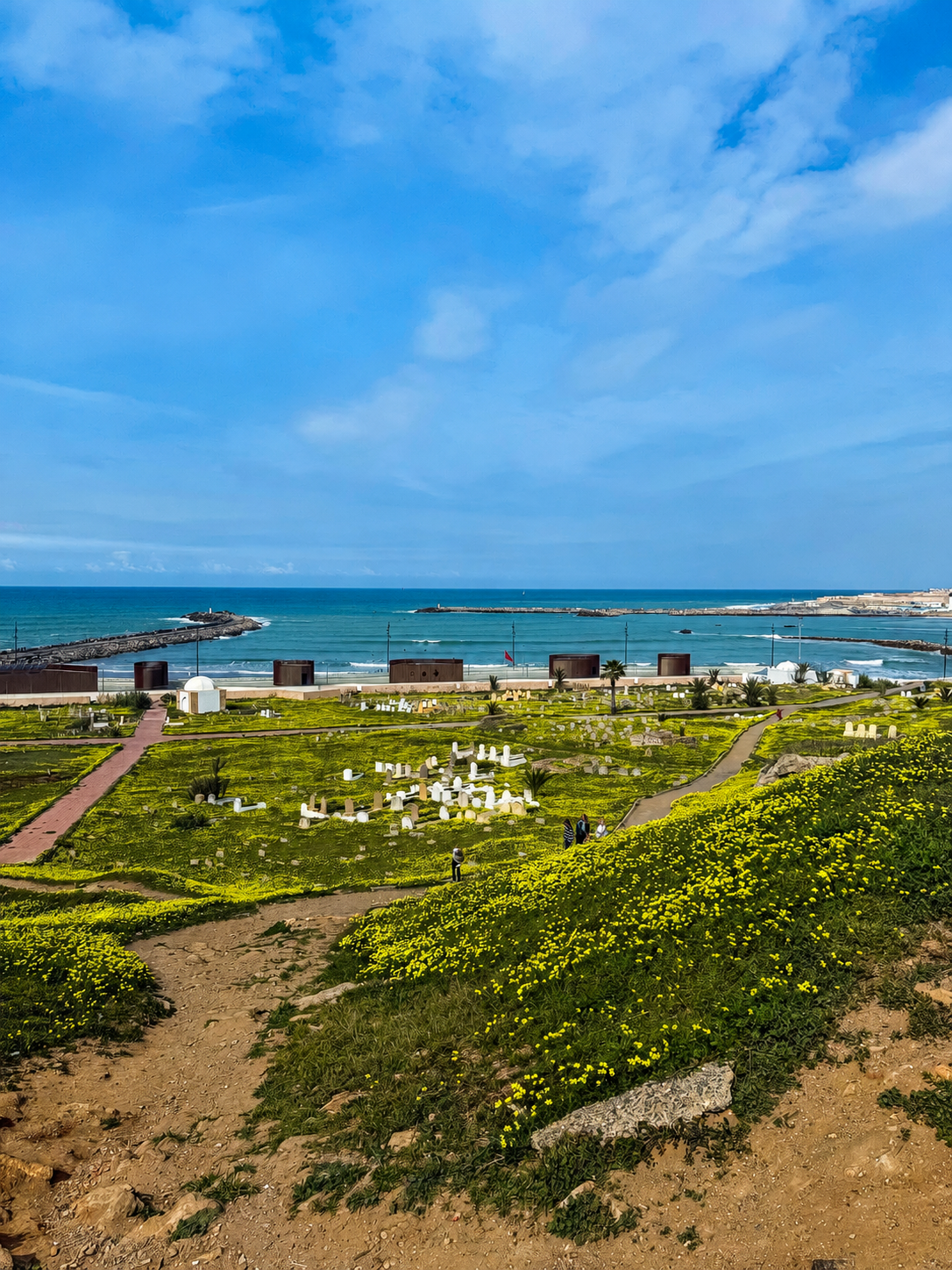
On the way out, across the road from the Kasbah, there was a graveyard, and I did the thing I always do.
I have a habit, when I travel, of stopping at graveyards. Not visiting, not on purpose. When I am walking past one, I stop, look in over the wall for a moment and keep walking. I have done it in four countries now and I could not tell you why.
Maybe it is because it was simultaneously a bitter reminder of the ones I have lost, and a rude awakening that I needed to be even more thankful for the time I'd been given. I cannot explain it better than that.
When I flew down to Marrakech it was on a small plane, and I sat next to a girl who would, a few days later, change the question I was asking myself.
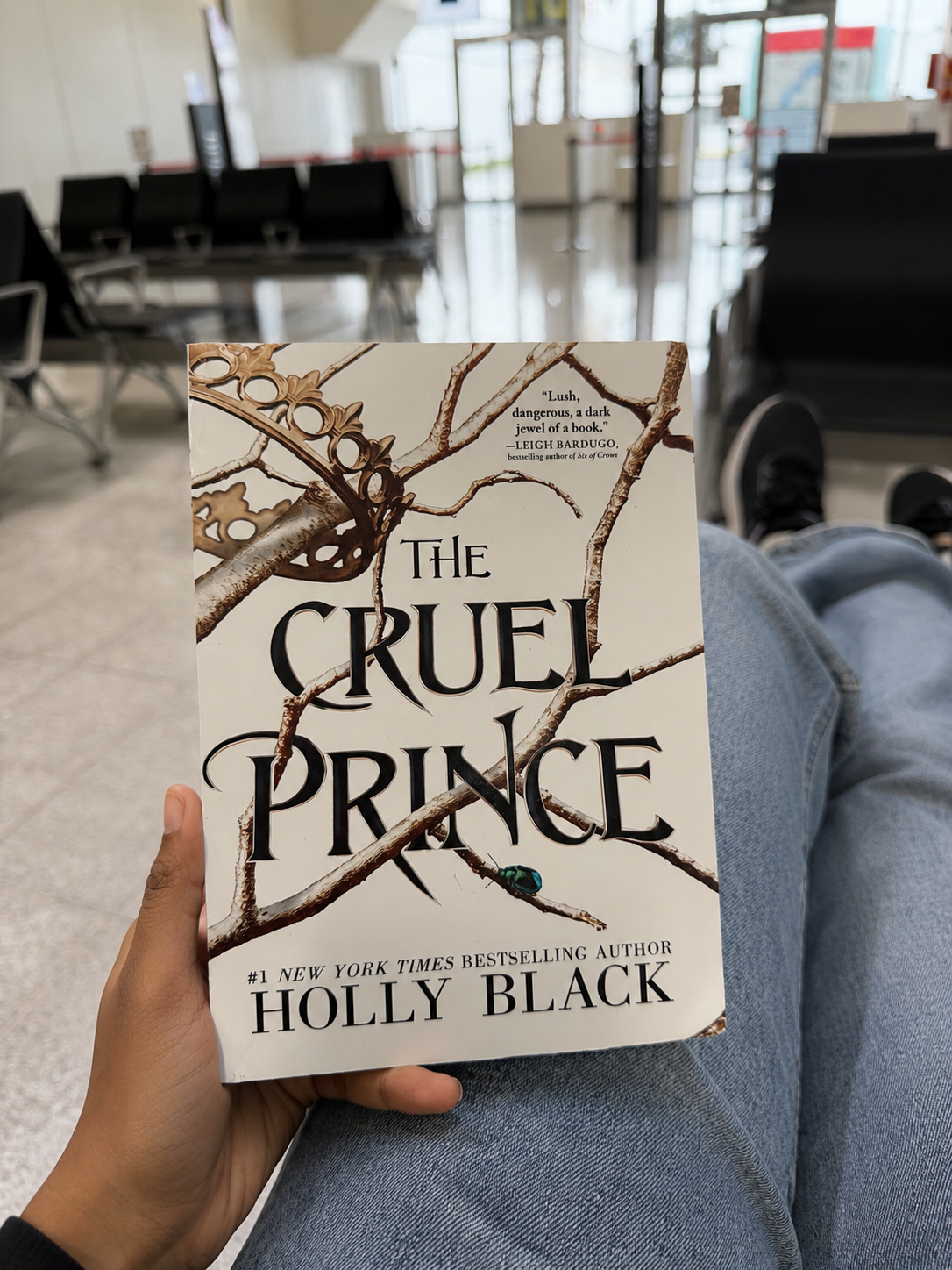
I had my book out, The Cruel Prince. I had just gotten to a plot twist I can't seem to remember now and made an excited squeak. "The second book is even better," she said. Her English came carefully, one brick at a time, and mine slowed to meet it. She was twenty-four, beautiful, with long black hair, grinning at me like we were best friends. We talked about the book, then books, then somehow about her. She told me things quickly, the way you do with a stranger you will never see again, how hard it was studying in another continent far from her parents, how she had gotten engaged just a week before. Within twenty minutes I had been invited to a girls' night with her friends, to which I promptly agreed. I looked out at the brown country tilting underneath us and thought about how I am not, at home, a person who says yes to that. Hanging out with a stranger from a plane, in a flat full of women I had never met? At home I would have invented a reason. Somewhere over the Atlantic I become braver, or less careful, or both. I never decided which.
There were six of us, all in some variation of sweatpants and hoodies. The movie was a French one and we talked over it, and within the hour we were trading the usual stories, somebody's mother, somebody's ex, somebody's sister who borrowed money and came back a stranger. I knew every conversation. I had had every conversation, on a sofa somewhere back home with the soft sounds of the city in the background. And I thought, with a flatness that was almost a disappointment, if I moved here, I would still be me. New ceiling, new friends, new word for bread, but still the same stories and conversations.
Youssef explained the doors to me. The colours, the metalwork, the stories they quietly told about the people inside. He taught me that guests are fed before they are questioned and told me to say Amazigh instead of Berber. It means something close to free people, and it is what they call themselves. Berber comes from the word outsiders used, the same root that gives us barbarian, a name for people whose language nobody could be bothered to learn.
So. Amazigh. I have said it that way since, ashamed that I didn't know earlier.
It was my birthday in the middle of all this, and it was a good time to check something off my bucket list. A hot air balloon, before dawn, over the land outside Marrakech. It was silent up there except for the burner, which roared and then cut out, roared and cut out. The land below was still half in shadow, red earth and olive groves and the flat roofs of villages where nobody was awake yet. Then the sun came up over the Atlas and the snow on the peaks turned pink, and the whole basket gasped at once, this involuntary collective sound, and the other balloons hung around us in the cold air like slow lanterns.
The landing had no dignity in it whatsoever. We came down hard into a field, the basket almost tipped onto its side. We were lucky. The balloon that landed next to us, not so much. That group ended up half lying on top of one another like washing while a man hauled at a rope and shouted in three languages and the contents of someone's bag went everywhere. Everyone laughed. The beautiful part and the ridiculous part were the same morning. I was reminded that beauty is sometimes shaped like that: lovely in the middle, and a mess at both ends.

I keep coming back to the saying-yes of it. At home I am careful. I do not eat the thing that might upset my stomach, do not get into the small boat, do not go to strangers' houses to watch films. I travel and I do all of it, gladly, as though I had left the careful version of myself at the airport with the liquids over a hundred millilitres. I do not fully understand why. "There's just something about travelling," we always say, as though that explains anything. Maybe travelling is simply one of the few times we stop rehearsing our lives and actually start participating in them. Maybe nobody here has met the careful one, so I am free to be the other for a while. I would love to tell you the bravery belonged to Morocco. I suspect it was mine all along, and all Morocco did was give me permission to use it.
So here is what happened, and it is not what I expected.
I went to Morocco half-believing I was looking for another life. The version of me who learned the market, who is lighter, funnier, braver. I have been looking for her in every city I have ever liked.
I did not find her. I found a girl on a plane who felt like an old friend inside twenty minutes. A woman tired of a man who would not listen. A mother bragging about her difficult daughter. A graveyard full of people who once thought their worries were the centre of the world. I found my own face, over and over, in different clothes, in different languages, carrying the same small bag of human things.
It should have disappointed me but it didn't. I thought I wanted another life, a brand new slate, somewhere nobody knew me. But every city eventually hands you back to yourself. What I want, I think, is not another life. It is more of this one. More people to recognise myself in. Morocco did not turn me into someone else, but it definitely made my one life a little less narrow than it was the week before.
Maybe that is all the wanting ever was. Not the door out. Just the longing for a little more room inside.
If you ever find yourself in Morocco, here is what I would actually tell you. Eat the tagine. Do the Atlas hike even if you are unfit, especially if you are unfit. Go on a road trip to Rabat. Get in the balloon and let the landing embarrass you. Stay in a riad and not a hotel, so you step off a shouting street into a still courtyard and feel the whole city envelop you. Leave your room. Especially in Marrakech, and especially in the evenings. Talk to the guide, the woman up at the Kasbah, the girl on the plane. Ask about their lives. Eat the thing you cannot name. The city does not reward people who hide in their hotels, and it does not owe you a new self when you come out. It just opens a little, for anyone willing to be a little curious…
And don't forget your jacket. It gets cold at night, whatever they tell you.
Elsewhere in this issue
A fascinating look at loneliness, belonging and the unusual ways people build connection.
→ In the Time It Takes a Kettle to Boil
On wanting, getting what we wished for and immediately looking toward the next thing.
A reflection on the tiny observations and encounters that slowly shape the way we understand others.